EN
EN  English
 عربى
عربى हिंदी
हिंदीForged vs. Cast Fluid Ends: Why Forging Is Critical for Frac Pumps
May 08, 2026
Content
- 1 The Pressure Problem: What Frac Pump Fluid Ends Actually Endure
- 2 How Casting Creates Structural Vulnerabilities
- 3 Why Forging Produces Superior Metallurgical Properties
- 4 Forging and Autofrettage: A Manufacturing Synergy
- 5 Real-World Consequences: Fatigue Cracking, Washouts, and NPT Costs
- 6 What to Look for in a Forged Fluid End Supplier
The Pressure Problem: What Frac Pump Fluid Ends Actually Endure
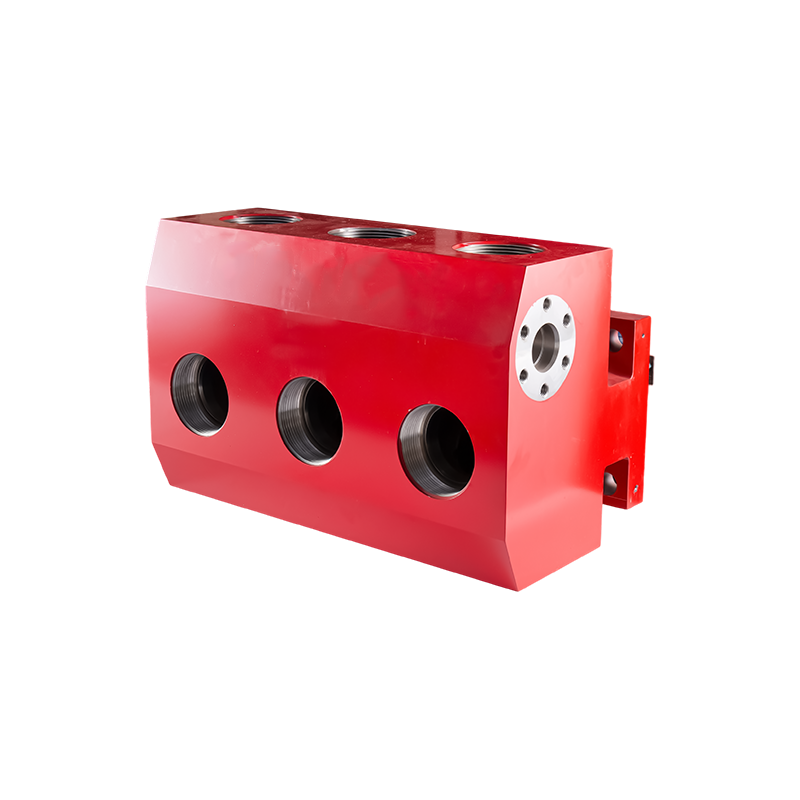
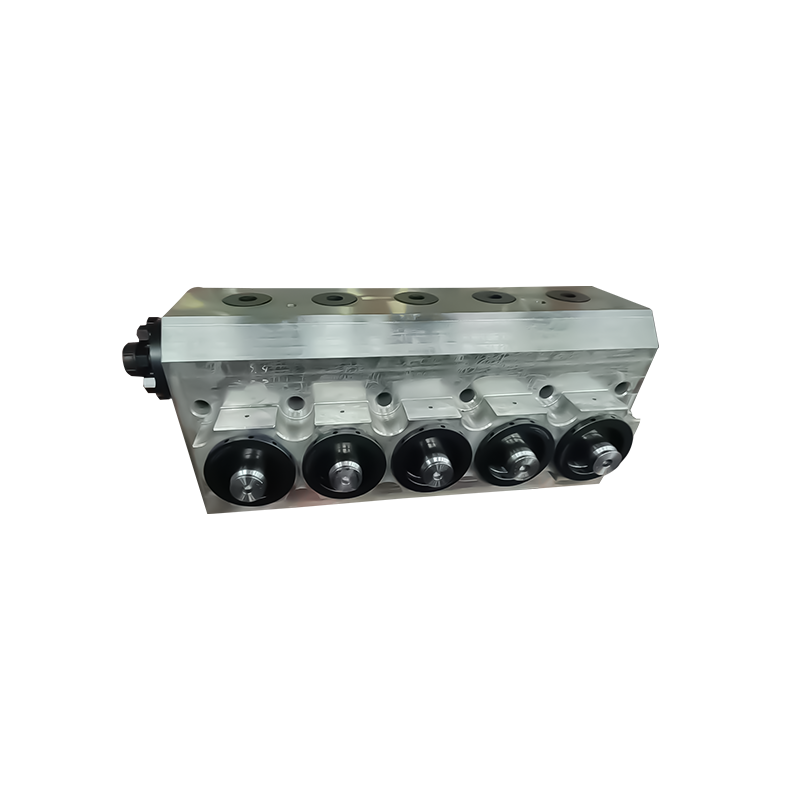
A frac pump fluid end does not operate under pressure—it operates under siege. Every stroke of the plunger subjects the block to pressures that routinely exceed 15,000 psi, and modern deep-formation jobs are pushing that ceiling higher. Add abrasive proppant-laden slurries cycling at several hundred strokes per minute, chemically aggressive stimulation fluids, and temperature swings across a 24/7 job schedule, and it becomes clear why the fluid end is the most failure-prone component on any high-pressure frac pump fluid end spread.
Against this backdrop, the decision between a forged and a cast fluid end block is not a procurement preference—it is an engineering decision with direct consequences for equipment lifespan, crew safety, and operational cost. The difference between the two starts at the atomic level, in the grain structure of the steel, and it compounds into every performance metric that matters in the field.
For a broader understanding of how fluid ends fit within the overall pump architecture, see this complete overview of frac pump design and components.
How Casting Creates Structural Vulnerabilities
Casting is a well-established metalworking method: the alloy is melted, poured into a mold, and allowed to solidify. For many industrial applications, the approach is perfectly adequate. For a frac pump fluid end, it introduces a set of structural liabilities that cyclic high-pressure loading will eventually exploit.
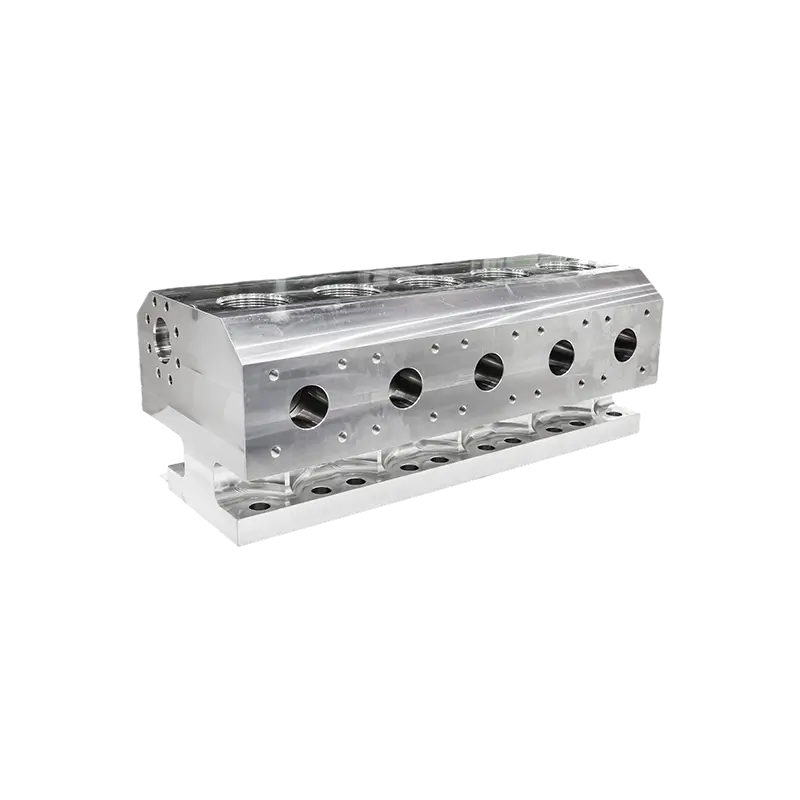
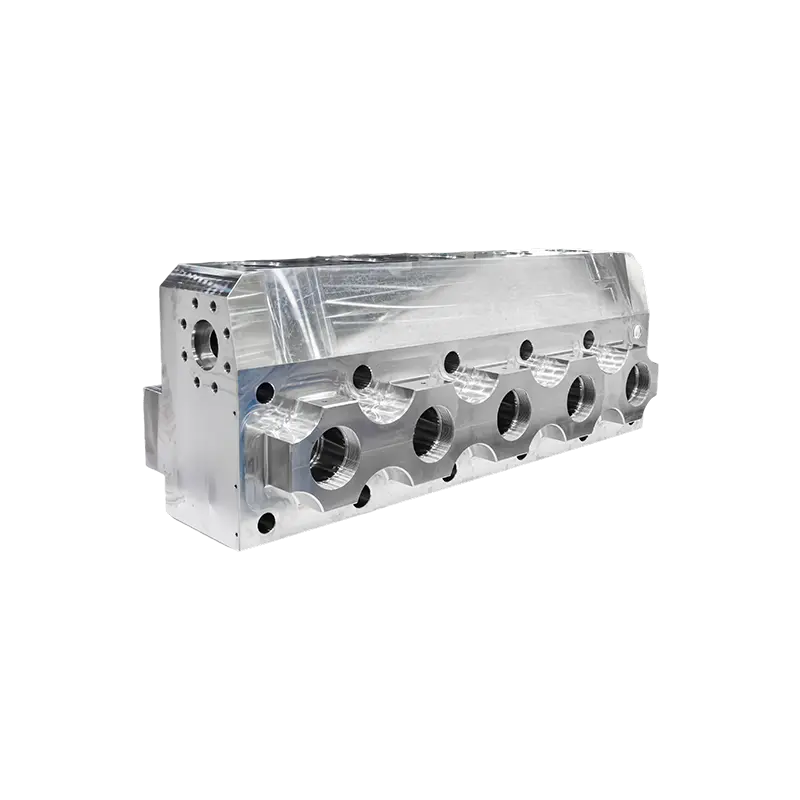
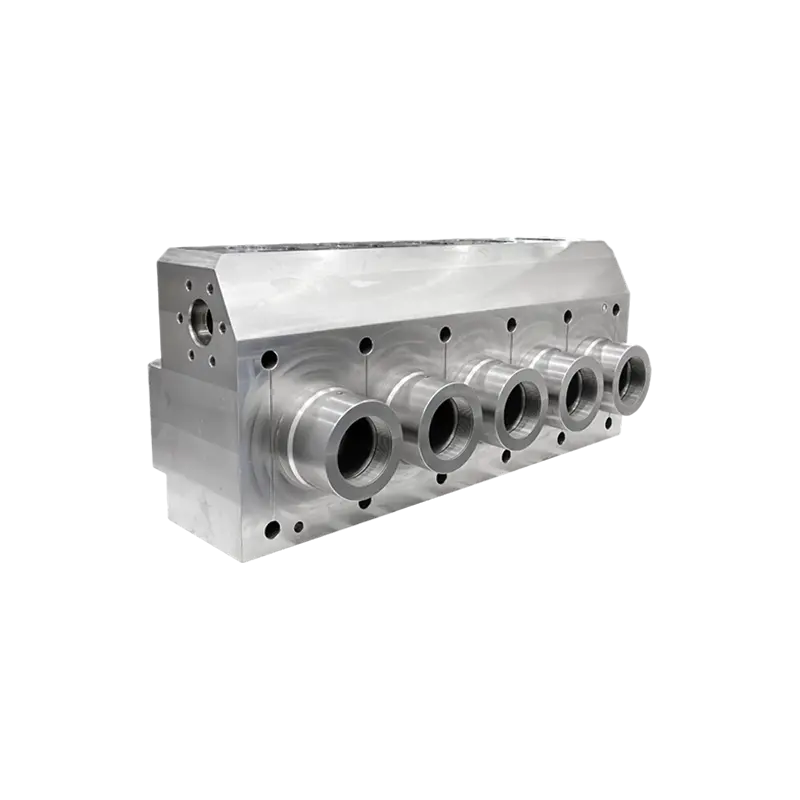
The core problem is solidification physics. When molten steel cools inside a mold, grains nucleate and grow in the direction of heat dissipation rather than in the direction of mechanical load. The result is a random, isotropic grain orientation—meaning strength is not concentrated where the part needs it most. At the intersecting bores of a fluid end block (the plunger bore, the valve bore, and the access bore converging in a single block), this is precisely where stress concentrations are highest under cyclic loading.
Solidification also introduces microstructural defects that forging cannot produce:
- Porosity and gas pores: Dissolved gases escaping during solidification leave voids in the matrix. Even small pores act as stress risers, dramatically accelerating fatigue crack initiation under cyclic pressure.
- Shrinkage cavities: As steel contracts during cooling, localized volume deficits create internal cavities that may not be detectable by standard surface inspection.
- Segregation: Alloying elements can concentrate unevenly during solidification, creating regions of lower hardness or reduced corrosion resistance within a single block.
None of these defects are guaranteed to cause immediate failure. Many cast components perform adequately at low pressure or static load. But a frac pump fluid end is neither low-pressure nor static. It cycles hundreds of millions of times over its service life, and every cycle probes every internal discontinuity for a weakness to propagate. In that context, the structural liabilities of casting are not theoretical—they are failure modes waiting to be triggered.
Why Forging Produces Superior Metallurgical Properties
Forging shapes metal while it remains solid. A heated steel billet is subjected to controlled compressive force—pressed, hammered, or rolled into the near-net shape of the finished component. This deformation does something casting never can: it aligns the grain structure along the geometry of the part, creating a continuous directional grain flow that follows the contours of the component rather than the direction of heat dissipation.
The mechanical consequences of this microstructural alignment are measurable and significant. Industry data consistently shows that forged components achieve approximately 26% higher tensile strength and 37% higher fatigue strength than comparable cast parts—a direct result of aligned grain flow, higher density, and near-zero internal defect rates. (Forging vs. cast comparative fatigue and yield strength data.) Cast iron, by comparison, achieves only around 66% of the yield strength of forged steel under equivalent load conditions.
Forging also eliminates the defect categories that make casting problematic in cyclic-load environments:
- No porosity: Compressive deformation closes any voids in the billet, producing a fully dense matrix with no internal gas pockets.
- No shrinkage cavities: Because the metal is never liquefied, solidification-driven volume deficits simply do not occur.
- Consistent alloy distribution: The deformation process homogenizes the steel chemistry across the block, ensuring uniform hardness, toughness, and corrosion resistance throughout.
For a fluid end block, the grain flow alignment is particularly valuable at the intersecting bore geometry—the highest-stress zone in the entire component. A properly forged block routes grain flow around those bore intersections, orienting the steel's resistance in the direction of the applied stress. (Technical overview of how forging improves grain flow and mechanical properties.) This is the metallurgical reason why forged fluid ends resist fatigue cracking from the inside out, not just at the surface.
| Property | Forged Steel | Cast Steel |
|---|---|---|
| Tensile Strength | ~26% higher | Baseline |
| Fatigue Strength | ~37% higher | Baseline |
| Yield Strength | 100% | ~66% of forged |
| Internal Porosity / Voids | Negligible | Present (process-inherent) |
| Grain Orientation | Aligned (directional flow) | Random (solidification-driven) |
| Deformation Before Fracture | ~58% area reduction | ~6% area reduction |
Forging and Autofrettage: A Manufacturing Synergy
Autofrettage—the process of pressurizing a fluid end block's internal bores beyond the material's yield point during manufacturing—is one of the most effective techniques for extending fatigue life. By inducing a layer of compressive residual stress at the bore surface, autofrettage counteracts the tensile stresses generated during pumping, delaying or preventing crack initiation. It can extend fluid end fatigue life by a factor of two to five compared to non-autofrettaged components.
What is less widely discussed is that the effectiveness of autofrettage is directly dependent on the quality of the base forging. The process requires a block that can be pressurized well above yield without triggering crack propagation from pre-existing defects. A cast block with internal porosity or micro-voids is a high-risk candidate: the autofrettage pressure itself can initiate or extend cracks from those defect sites, turning a life-extension process into an accelerated failure mechanism.
A forged block, free of internal voids and with a uniform, dense grain structure, tolerates autofrettage loading predictably and safely. Manufacturers can use a larger forging billet—removing less material during bore machining—which preserves thicker wall sections and allows deeper compressive residual stress layers to form. The result is a fluid end block that benefits fully from autofrettage rather than being undermined by it.
This manufacturing synergy—forging enabling optimal autofrettage, autofrettage maximizing the fatigue life of a forged block—is one of the clearest practical arguments for specifying forged fluid ends in high-pressure applications. It is not just about the forging in isolation; it is about what the forging makes possible downstream in the manufacturing process.
Real-World Consequences: Fatigue Cracking, Washouts, and NPT Costs
The dominant failure mode for fluid ends in high-pressure fracturing is fatigue cracking at the intersecting bores. It does not happen in a single event. A micro-crack initiates—often from a stress riser created by a surface pit, a porosity void, or a corrosion feature—and propagates incrementally over thousands of pressure cycles. By the time the crack is detectable, the block is typically close to functional failure.
When a fluid end cracks or washes out mid-job, the consequences extend far beyond the cost of the replacement block itself. A pump taken offline during a fracturing stage forces a rate reduction or a complete job interruption. Depending on the stage design and wellbore conditions, this can mean a stage that must be abandoned, perforations that fail to clean up, or formation damage from incomplete stimulation. The cost of non-productive time on a modern high-horsepower spread—across crew, equipment, and lost completion efficiency—can reach tens of thousands of dollars per hour.
Cast fluid ends, with their inherently higher defect density and lower fatigue resistance, are statistically more likely to reach that failure threshold sooner. Forged fluid ends, with their superior fatigue strength and clean grain structure, extend the interval between replacements. Across a full pump campaign, that difference accumulates into a measurable advantage in fluid end parts and replacement costs and in total operational uptime.
It is also worth noting that fluid end failures rarely occur in isolation. Cracking or washout events subject adjacent components—premium frac pump plungers engineered for cyclic loading, valve seats, and packing assemblies—to abnormal stress and fluid exposure, often triggering secondary failures that compound the downtime and repair cost. The fluid end block sets the baseline for the entire front-end assembly. An unreliable block is expensive not just in itself, but in what it costs downstream. For perspective on how power end performance affects overall pump reliability, failures in any one subsystem rarely stay contained.
What to Look for in a Forged Fluid End Supplier
Not all forgings are equal. Specifying "forged" on a purchase order does not guarantee the metallurgical outcomes described above—it requires the right billet material, heat treatment protocol, and process controls. Here is what to evaluate when qualifying a supplier:
- API Q1 certification and full material traceability: Every fluid end block should carry a traceable pedigree from billet to finished part, including heat number, alloy specification, and mechanical test results. API Q1-certified suppliers maintain documented quality systems that enforce this traceability.
- Billet quality standards: The raw forging billet should meet cleanliness standards for inclusion content. High sulfur content or excessive non-metallic inclusions in the billet will negate the grain flow benefits of forging. Ask for steel mill certification documents.
- Non-destructive testing (NDT) protocols: Finished fluid end blocks should undergo ultrasonic flaw detection to verify internal integrity. Magnetic particle inspection (MPI) or dye penetrant testing (DPT) should be applied to bore surfaces and critical geometry zones. A supplier unable to provide NDT records on finished blocks is a risk.
- Autofrettage capability: If the supplier offers autofrettaged fluid ends, confirm that their process specifies the target bore pressure, the yield strength of the forging, and the resulting residual stress depth. Autofrettage applied without documented process parameters offers no verifiable life-extension benefit.
- Heat treatment documentation: Quench and temper cycles determine the final hardness profile of the fluid end block. Supplier documentation should specify the target hardness range (typically 285–341 HB for carbon steel grades commonly used in frac service) and confirm that the finished part is within spec.
- Compatibility and interchangeability: Premium forged fluid ends should be dimensionally interchangeable with major OEM specifications, so fleet operators can standardize across pump models without custom fitting or downtime for adaptation.
The right forged fluid end supplier is not simply a parts vendor—it is a manufacturing partner whose process discipline directly determines how long your equipment stays in the field between replacements.